
Official Rules
The complete published WRPSA competition ruleset, version 1.0.
Under WRPSA ruleset v1.0, two players reveal Rock, Paper, or Scissors simultaneously on the fourth cue, “Shoot.” Rock beats Scissors, Scissors beats Paper, and Paper beats Rock; matching actions are ties and are replayed. The standard WRPSA match is first to two decisive-round wins. The published rules also define legal gestures, timing fouls, penalties, event formats, referee authority, protests, and conduct for events that adopt this ruleset.
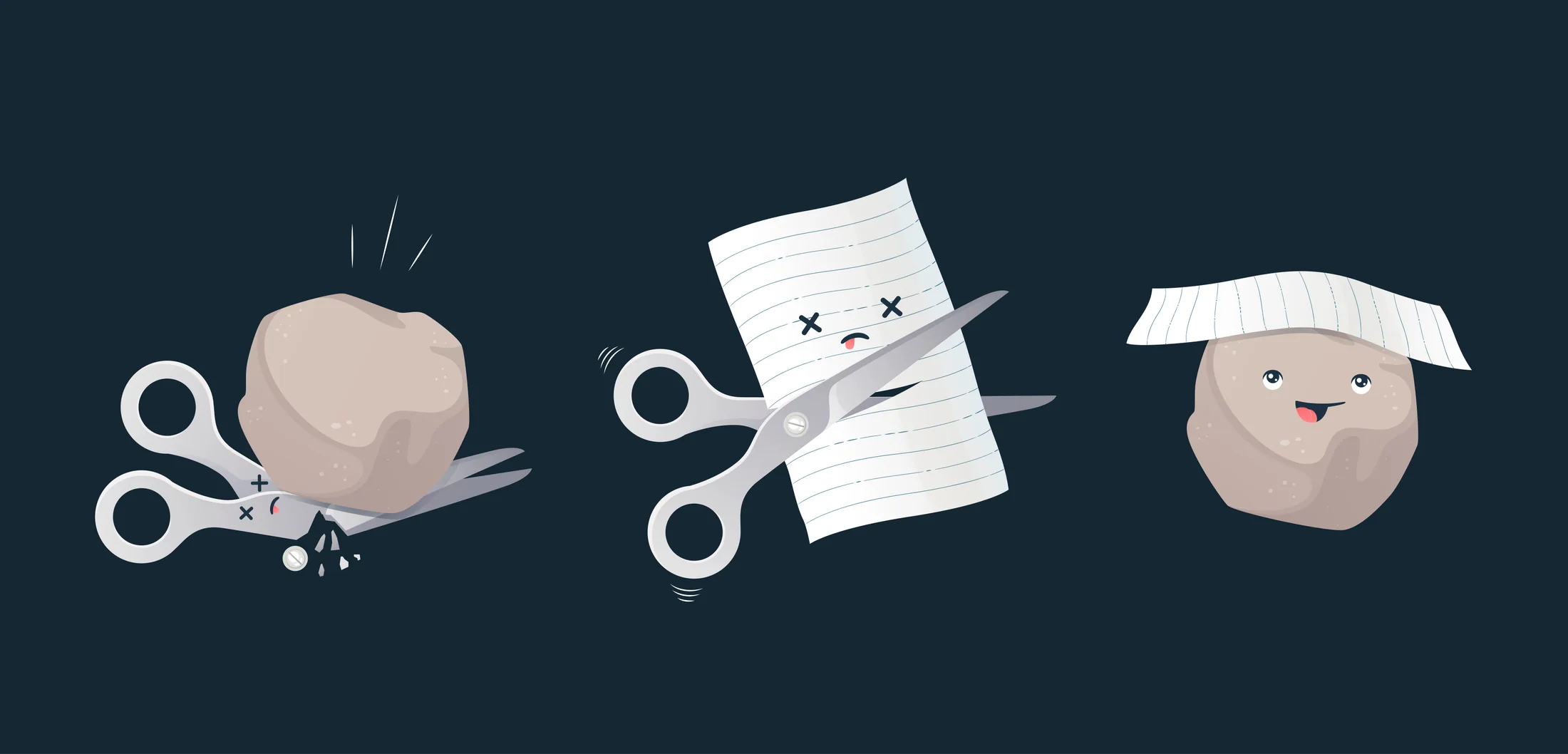
The Laws of Rock Paper Scissors
- Current edition
- Version 1.0 (2026 edition)
- Published
This page is the current web edition of WRPSA ruleset v1.0. The downloadable document is a fixed printable quick reference for organizers, referees, teachers, players, and journalists who need the same published procedure offline.
Download The Laws of Rock Paper Scissors v1.0 (PDF)Throw Mechanics
Both players face each other, one hand in a loose fist at chest or waist height. The referee (or both players, by mutual agreement) calls the cadence: "Rock, Paper, Scissors, Shoot!" Both players form and reveal their throw simultaneously on "Shoot." Not before. Not after. On it.
The Three Valid Throws
- Rock - Closed fist. Beats Scissors. The gesture you were already making.
- Paper - Flat, open hand, palm horizontal. Beats Rock. Counterintuitive but correct.
- Scissors - Index and middle fingers extended in a V. Beats Paper. The one that requires effort.
Any other hand shape is illegal in official WRPSA play. No "gun." No "well." No extra fingers. No Lizard. No Spock. The throw must be a clear, unambiguous shape. If there's any doubt about what you threw, it's a problem.
Throw Timing
Both players throw at the same instant on the final cue. During the countdown, keep your hand in a closed fist. Opening or changing your hand shape early is a false start. Delaying your throw to react after seeing your opponent's hand is a late throw, which is one of the most serious fouls in competitive play. It's also one of the most embarrassing ways to lose a match.
Match Format
Best-of Rounds
Standard matches use a best-of-3 format (first to 2 wins). Organizers may use longer formats for later rounds, but the number of rounds is always odd. This guarantees a decisive winner, which is the whole point of having rules.
Round Resolution
- Rock beats Scissors
- Scissors beats Paper
- Paper beats Rock
If both players show the same throw, the round is a tie (stalemate) and is replayed immediately. There is no limit on stalemate replays. We've seen some go on for a while. It's fine. Everyone's having a good time.
Winning
The player who wins the majority of rounds wins the match. A 2-0 or 2-1 wins a best-of-3. Once one player reaches the majority, the match ends immediately. No victory laps required.
Legal and Illegal Throws
Only Rock, Paper, and Scissors. That's the whole list. Some specifics:
- Paper clarity: Open hand must be horizontal (palm down). A vertical "handshake" position doesn't count. It has to look like Paper, not a greeting.
- Scissors clarity: Must clearly show a two-finger V. Any ambiguous or partially closed hand is disallowed. Commit to the V.
- Visibility: Your throw must be fully visible to your opponent and the referee. Hiding your hand or using clothing to obscure the throw results in a replay or foul. We shouldn't have to say this, but here we are.
"Dynamite," "Lizard," "Spock," and novelty gestures are banned from official competition. Fun variations exist, but they are not part of the WRPSA ruleset. This is the three-throw game. We committed.
Fouls and Penalties
| Foul | First Offense | Repeat Offense |
|---|---|---|
| False start | Warning + round replay | Round loss |
| Late throw | Immediate round loss | Match forfeit |
| Illegal throw | Round loss (opponent may allow replay) | Match forfeit |
| Stalling / delaying | Warning | Round loss |
| Unsportsmanlike conduct | Warning | Disqualification |
In extreme cases (physical aggression, confirmed cheating, blatant harassment), the referee may declare an immediate match forfeit or tournament disqualification. Don't be that person.
Tournament Structure
Bracket Formats
An event adopting WRPSA ruleset v1.0 may use single elimination, double elimination, Swiss rounds, or group stages feeding a knockout bracket. The organizer must announce the selected format before play. This statement defines permitted formats; it does not claim which format most events use.
Advancement
In elimination brackets, winners advance. In group or Swiss play, the organizer must announce the points, standing calculation, and tie-break procedure before play. The v1.0 quick reference permits head-to-head results or additional RPS throws as announced tie-breaks.
Because each match uses an odd number of rounds and ties are replayed, there is no need for a separate sudden death mechanic. The game handles its own drama.
Judging and Appeals
Referee Authority
A referee assigned by the event enforces timing, calls fouls, and determines each round under this ruleset. The ruling is final during play, subject to the stated post-match protest process.
Appeals
A player who believes a serious rule violation occurred may file a formal protest immediately after the match. Tournament officials review evidence (video, witnesses, device logs) and may overturn results only for clear rule breaches. Subjective complaints generally do not change outcomes. "I had a feeling" is not evidence.
Code of Conduct
- Sportsmanship: Be respectful. No excessive trash talk, insults, intimidation, or physical contact. This is a hand game. Keep it classy.
- No delaying: Keep the match moving. Stalling draws penalties. Nobody came here to watch you think.
- Visible throws: Hands must be free and visible. No gloves, props, or clothing that could obscure the throw. Smart devices (earpieces, smartwatches) are banned. It's your hand against their hand. That's it.
- Consequences: Minor misconduct earns warnings. Serious or repeated violations lead to round loss, match forfeit, or tournament disqualification.
Frequently Asked Questions
Is Rock Paper Scissors really a sport?
WRPSA treats Rock Paper Scissors as a structured competitive game when it is played under this ruleset. Whether a law, school, or sports body classifies it as a sport depends on that organization and context.
What happens if both players throw the same thing?
It's a tie. The round is replayed immediately. No limit on replays. Eventually someone will blink.
Can I use Lizard or Spock?
Not in official WRPSA competition. Only Rock, Paper, and Scissors are legal. See RPS Variations for when you want more chaos.
How do I enter a tournament?
Use Discover to see events that are currently published. Each event page states its status, eligibility, and available registration path; an account may be required.
Revision history
Every published edition of the ruleset, newest first. A rule that changes gets a new version number; wording and typographical fixes do not.
| Version | Published | Changes |
|---|---|---|
| 1.0 | First published edition. Consolidates throw mechanics, match formats, the legal-throw list, the foul schedule, tournament structure, judging and appeals, and the code of conduct into one numbered document. |
Citing this ruleset
Cite the numbered edition when the version matters: World Rock Paper Scissors Association, Official Rock Paper Scissors Rules, version 1.0 (2026 edition). A later rules change requires a new version and revision entry; this page URL remains the canonical web location.
Ready to play?
Put these rules into practice. Play your first match in seconds.