
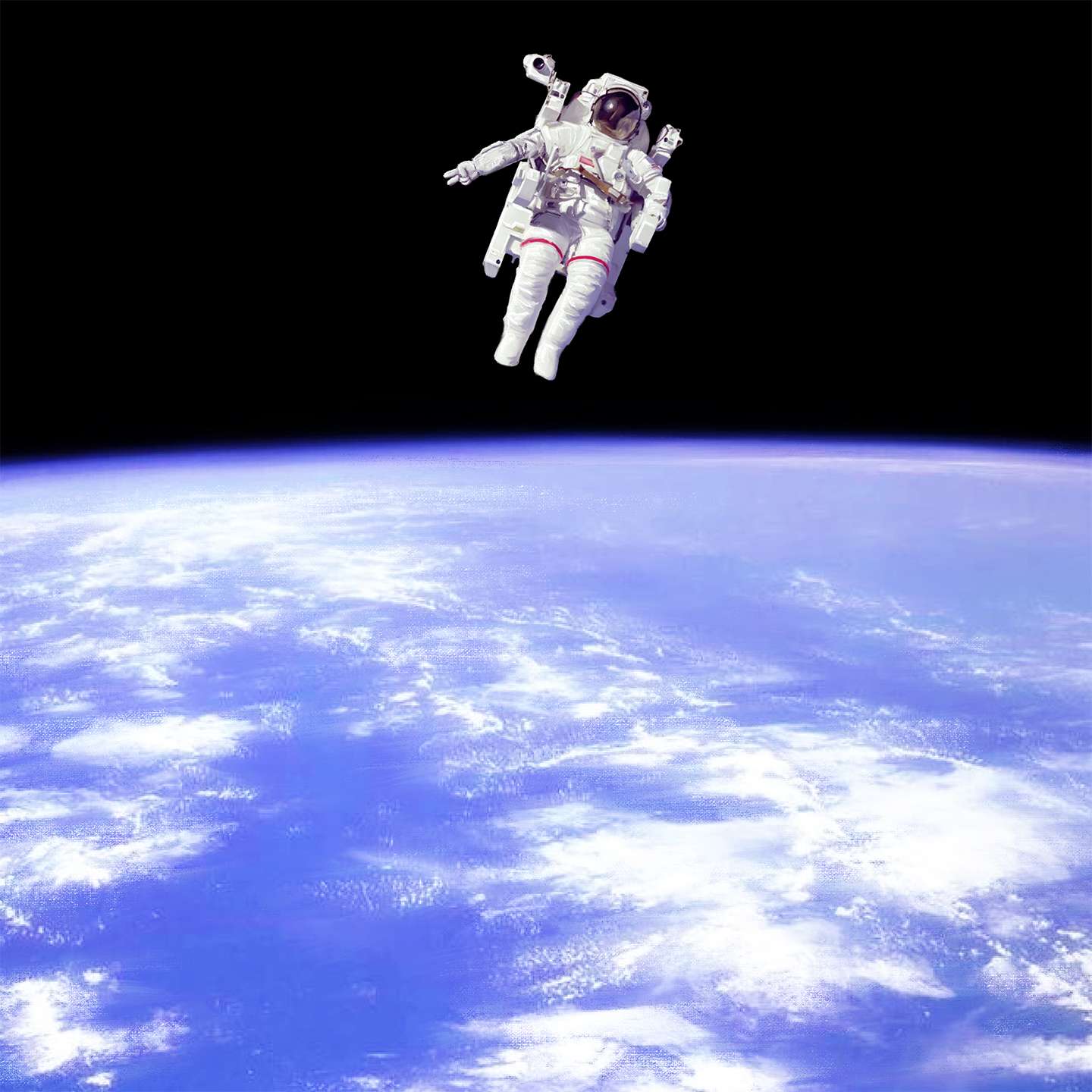
On February 7, 1984, Bruce McCandless II stepped away from the Space Shuttle Challenger and became the first human being to float freely in space with no tether connecting him to anything. The device he was testing was the Manned Maneuvering Unit, a nitrogen-propulsion jetpack that allowed him to fly independently up to 100 meters from the shuttle. The photograph of him hanging in the void, Earth curving below, shuttle out of frame, nothing between him and the universe in any direction, became one of NASA's defining images.
What makes the image remarkable is not the technology but the isolation. McCandless is completely alone in a way that no human being had been before. No communication system failure, no equipment problem, and he is unreachable by anything. He is also, the photo suggests, entirely calm. The suit shows no visible tension. The posture is controlled. The man is floating in the middle of nothing and looks like he's waiting for a bus.
Rock Paper Scissors in this context is an interesting thought experiment. The game requires two players and a shared space. Space removes both. There's nobody to play against. The throw you make has no opponent to reveal against. The game in its most radical form — stripped of another person, stripped of outcome, stripped of stakes — is just a hand making a shape in a vacuum.
What remains is the gesture itself. The choice you would have made if there had been someone to play. Whether you're the kind of person who throws Rock when nobody is watching, or Paper, or Scissors. The answer probably says more about you than most of your answers to more important questions.
McCandless flew in space twice, the second time in 1990 during the Hubble Space Telescope deployment mission. He died in 2017. The photograph continues to circulate as one of the canonical images of human achievement in the space age, and also as one of the loneliest images ever taken.