
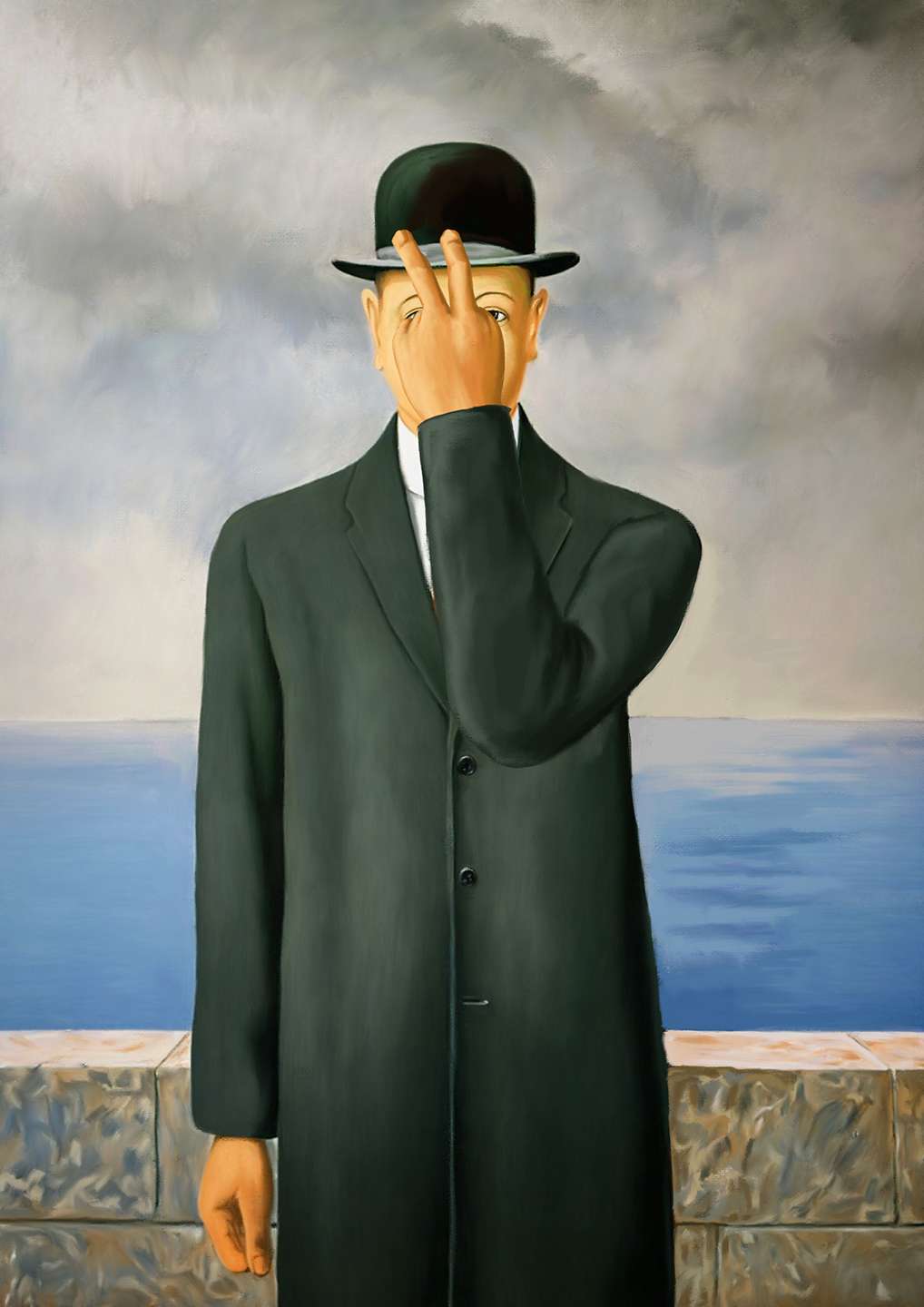
Rene Magritte painted Son of Man in 1964, one year before his death. The figure is a man in a bowler hat and dark suit, standing before a low stone wall with the sea visible behind him. His face is almost entirely obscured by a green apple floating at face level. You can see his eyes peeking over the top edge of the apple. His expression is not visible.
Magritte said about the painting: "Everything we see hides another thing, we always want to see what is hidden by what we see." This is his central preoccupation across most of his work. The pipe that is not a pipe. The man who is not a man because his face is an apple. The image that shows you something and hides something else by showing it.
Rock Paper Scissors operates on a version of the same logic. What you throw hides what you might have thrown. The reveal shows one thing and conceals the decision process that produced it. A clean Rock throw gives your opponent no information about whether you chose Rock because you're playing Avalanche, because you thought they'd throw Scissors, because you went with your default opening, or because you were genuinely randomizing. The visible outcome hides the reasoning. They have to infer backward from the reveal, through patterns and tendencies and behavioral research, to reach a claim about what you might throw next.
Magritte's painting is in a private collection and has been reproduced so many times that the reproduction has mostly replaced the original in cultural memory. The man in the bowler hat is more familiar than the name of the painter for many people who recognize the image. His apple obscures his face. Your throw obscures your next throw. The game continues.