
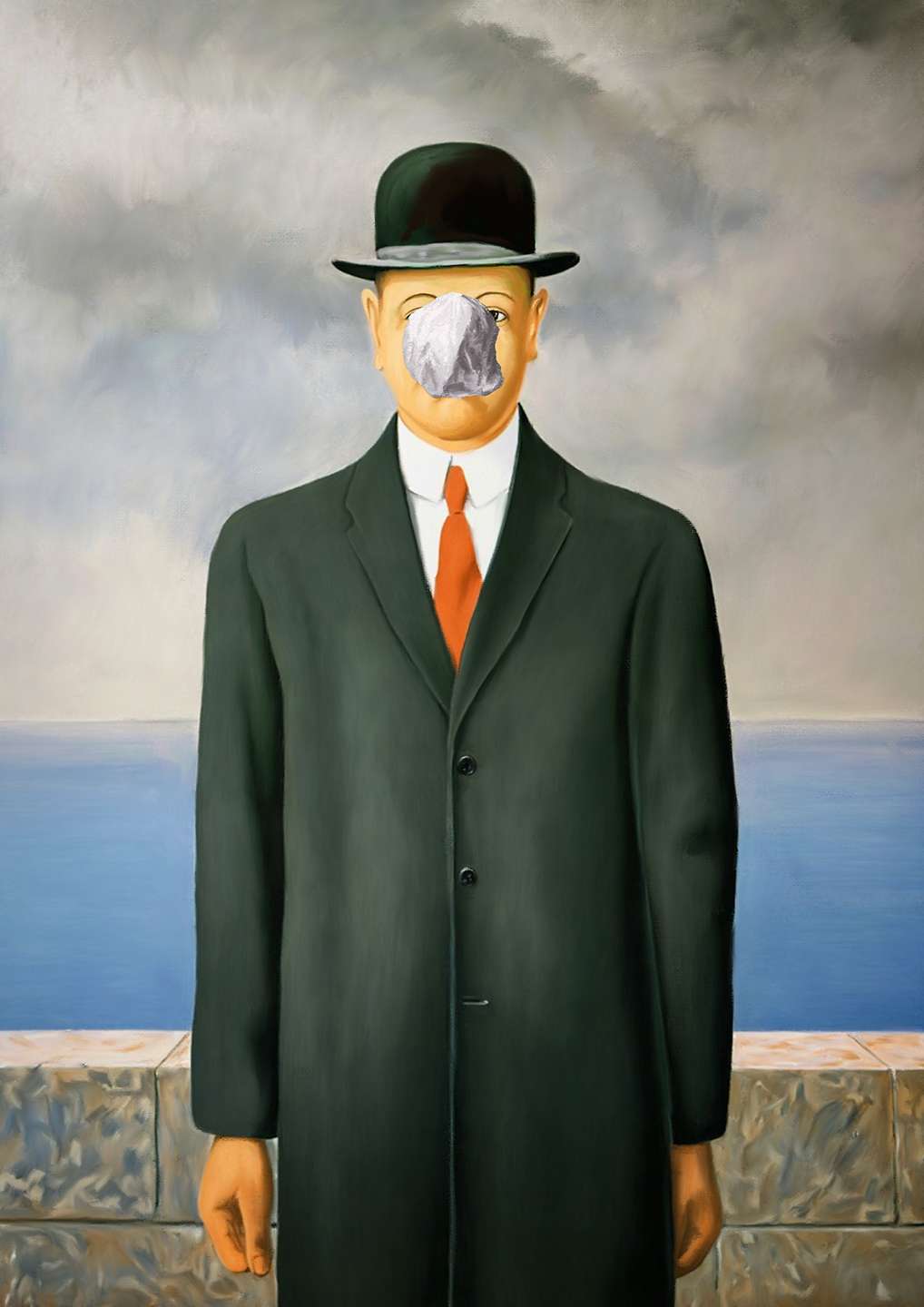
Magritte's Son of Man presents you with a person whose face is hidden. You know he is standing, wearing a suit, positioned before a wall and the sea. You know nothing about his expression, his state of mind, or the micro-tensions in his face that competitive players learn to read during the priming phase of a throw.
The competitive version of this scenario — an opponent with no visible face — sounds like an advantage for the person in the hat. No tells leaking from his expression. No jaw tension, no eye movement, no the thousand small signals that experienced players have catalogued over years of competition.
But the argument runs the other way too. Tells come from all of the body, not just the face. The slight commitment of the shoulder, the early closure of the fingers, the off-rhythm pump during the count that indicates someone deciding late — these are readable in the hands and arms regardless of what the face is doing. An opponent who has removed one source of information hasn't eliminated the read. He's just reduced it to its physical components.
The deeper problem with the Magritte figure as a Rock Paper Scissors opponent is that his ambiguity goes in both directions. You can't read his face. But you also can't know what he knows. The apple hides his expression. It also hides whether he has been studying you for the past three rounds, whether he knows about win-stay lose-shift, whether he has a gambit planned or is genuinely randomizing. The obscured face makes him harder to read, but it also makes the meta-game harder to navigate. You don't know how many levels deep he's thinking, which is the most important thing to know in competitive RPS.
The bowler hat and the apple remain unexplained. This is exactly right.