
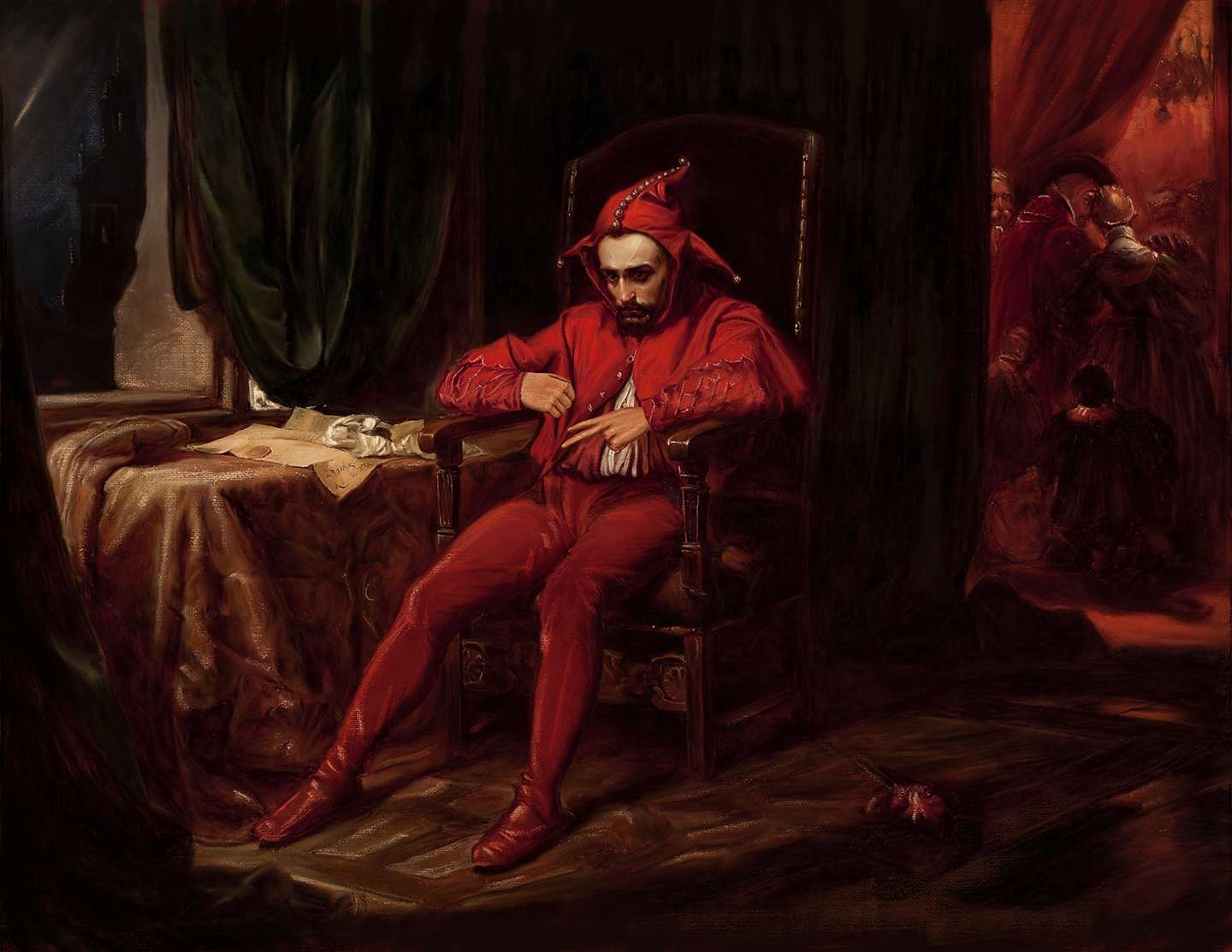
Jan Matejko was nineteen years old when he painted this. The historical subject is Stańczyk, court jester to three Polish kings in the early sixteenth century, who was documented as one of the few people in the court permitted to speak uncomfortable truths to power. Jesters occupied a specific social role: their fool's license allowed them to say things that would cost anyone else their position.
Matejko painted him at the moment of receiving news that the Russian army had captured Smolensk in 1514, a significant Polish military defeat. In the background, through the curtained doorway, the court is celebrating. In the foreground, alone in a side room, Stańczyk sits in his jester's costume with an expression that has no jesting in it at all. He knows something the celebration doesn't.
The competitive relevance of this painting to Rock Paper Scissors is the information asymmetry. Stańczyk has information nobody else in the building has processed yet. The celebration is proceeding on the basis of an outdated understanding of the situation. This is the state you're trying to achieve against an opponent in competitive play: knowing something they don't, or more accurately, knowing your own patterns and tendencies clearly enough that your opponent's model of you is less accurate than it should be.
The jester's license was a kind of strategic ambiguity. Stańczyk could say things others couldn't because the fool's role made his statements formally uncountable. His truths were coded as jokes, which gave him access to a category of communication unavailable to anyone playing a straight game. In RPS terms, this is the false prime: using the expected behavior as cover for the actual intention.
Matejko's painting is at the National Museum in Warsaw. The expression on Stańczyk's face is still being studied. The news he's received is still accurate.