
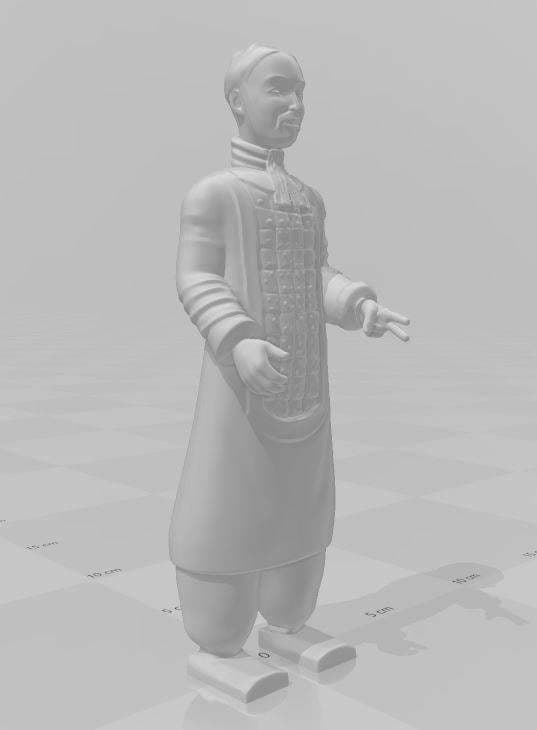
The Terracotta Army was discovered in 1974 by farmers digging a well near Xi'an, China. Subsequent excavation revealed more than eight thousand clay soldiers, along with cavalry, chariots, and bronze weapons, arranged in battle formation in three large pits. They were constructed under Emperor Qin Shi Huang beginning around 246 BC, when he was thirteen years old and had just ascended to the throne of the Qin state. The project continued for nearly forty years until his death.
The generals are distinguishable from ordinary soldiers by their double-layered armour, their elaborate headdress, and their posture — which is upright and commanding rather than the combat-ready stance of the infantry. They were positioned at the back of the formation where command decisions were made, not where fighting happened. Their role was to direct rather than to engage.
Command decisions in the context of Rock Paper Scissors are made faster than battle command decisions, but they share a structure: information is incomplete, the opponent has their own intentions that you can't directly observe, and the outcome depends on your read being accurate more often than theirs. Qin commanders who were good at this — at inferring from partial information, at pattern recognition under time pressure, at calibrating between predictable and unpredictable behavior — would be identifiable to the RPS community as natural competitors.
The terracotta generals have been standing in formation for two thousand two hundred years. The figures are made to last indefinitely. Rock Paper Scissors is made to last thirty seconds. Both have been around since before most of the things we currently consider permanent.