
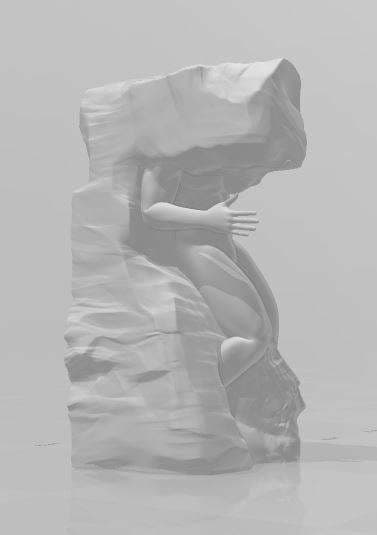
Michelangelo's four "Prisoners" or "Slaves" were intended for the tomb of Pope Julius II, a project that went through six different designs over forty years and was never completed. The figures are still partially embedded in the marble from which Michelangelo was extracting them. The Atlas Slave is the one whose head and upper body have emerged but whose lower body remains stone. He holds a weight above his head, or appears to, in the posture of someone bearing an impossible load.
Vasari and later scholars have read these unfinished figures as intentional: Michelangelo believed the figure was already inside the marble and the sculptor's job was to reveal it. Whether this is accurate to Michelangelo's method or retroactive interpretation, the effect is that you're looking at someone mid-emergence. Not fully formed. Not yet free.
Rock Paper Scissors is structurally opposed to this condition. The game requires no emergence. You don't need to have finished becoming anything to play. The entry requirement is the ability to make one of three hand gestures on a synchronized count. That's it. No preparation, no qualification, no progress toward readiness. The Atlas Slave is frozen mid-emergence, between what he was and what he's becoming. The game begins wherever you are.
The WRPSA art series finds this contrast worth marking. Most competitive activities reward investment in development. The athlete who trained longer, the chess player who studied more games, the musician who practiced through thousands of hours — these are the people who usually win. Rock Paper Scissors rewards all of that preparation, but it also gives an equal start to the person who walked in cold. The marble holds the Atlas Slave. The game doesn't.
The four Slaves are in the Accademia Gallery in Florence, in a hall leading to the David.