
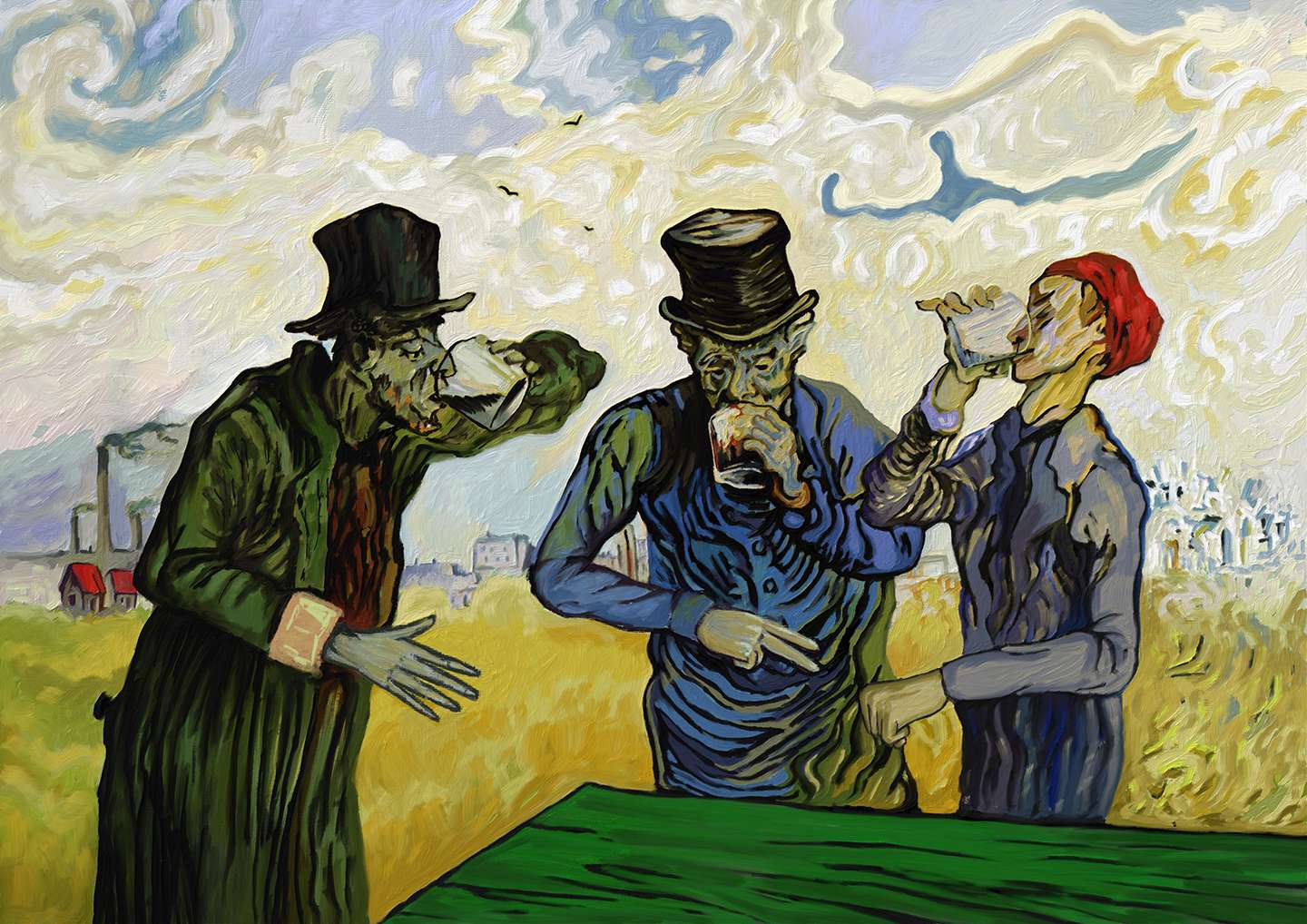
Vincent van Gogh painted his version of The Drinkers in January 1890 while committed to the Saint-Paul-de-Mausole asylum in Saint-Rémy-de-Provence. He had checked himself in voluntarily following the incident with his ear in December 1888, and spent a year there producing some of his most recognized work: Starry Night, his series of irises and almond blossoms, and a number of copies of paintings by artists he admired but couldn't afford to have in front of him as originals. Daumier was among them. Millet was another.
The Drinkers shows figures at a table, deep in the kind of drinking that has moved past celebration into something more sustained. They are not celebrating anything. They are maintaining a condition.
The company you keep at that stage of a night is different from the company you keep at the beginning of it. The social performance layer has dropped. Nobody is managing impressions. The people still at the table at this hour are there because they want to be, or because they can't think of a reason to leave, or because whatever is outside the bar is harder than what's inside it. Rock Paper Scissors emerges from this context with no preamble, no justification, no stakes beyond the next round of whatever is on the table. Two people who have nothing left to prove to each other, running a game that requires nothing.
Van Gogh produced this painting in a hospital with restricted access to materials, working from a black and white print of the original. The colors he chose are his own, which is to say they are nothing like what Daumier would have chosen. The painting shows Van Gogh's state of mind at least as much as it shows Daumier's composition. The Art Institute of Chicago owns it. Van Gogh was dead six months after finishing it.