
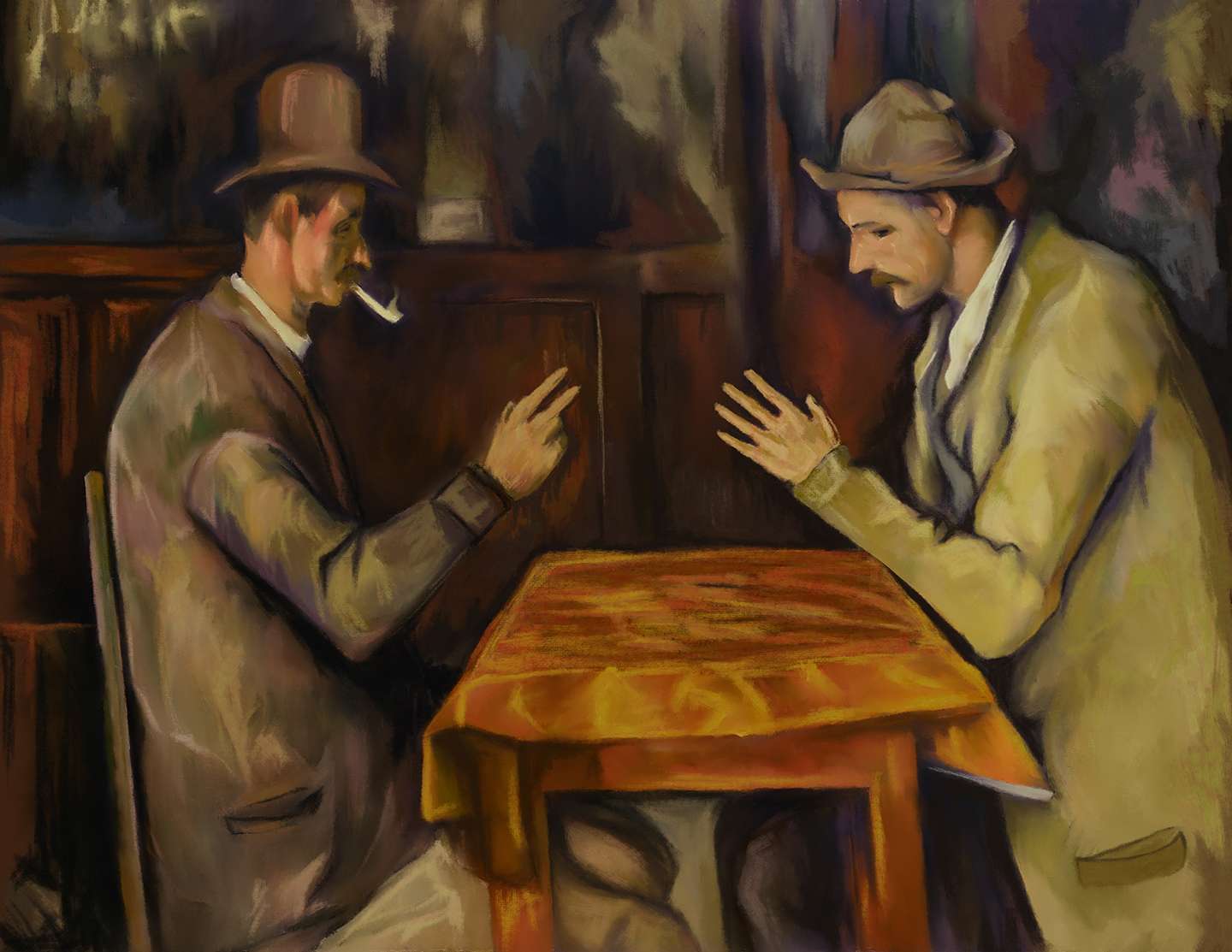
Paul Cézanne painted The Card Players in multiple versions during the early 1890s in the Aix-en-Provence region of southern France. The subjects were local agricultural workers — farm laborers from his family's estate and from the surrounding area. He painted them from life, repeatedly, studying the way that focused attention on a game changes how people hold themselves and relate to each other.
The versions range from large multi-figure compositions to intimate two-person studies. The two-player versions have the most competitive force: two men at a table, cards in hand, concentrated entirely on each other. There is no background that competes for attention. There is no social performance. The game is all there is.
In 2011, one of the Card Players versions sold to the Royal Family of Qatar for a reported $250 million, making it the most expensive painting ever sold at that time. The subject matter — ordinary men playing an ordinary card game in a provincial farmhouse in nineteenth-century France — is about as far from the usual content of world-record auction results as it's possible to get. Cézanne wasn't painting nobility or religious subjects or history paintings. He was painting workers playing cards.
The recognition that game-playing — focused, serious game-playing between people of equivalent skill — is a worthy subject for serious painting is something the WRPSA art series takes as foundational. The Card Players are paying attention to each other in the way that competitive players learn to pay attention: completely, without the social noise that usually mediates two people sharing space. Rock Paper Scissors has a shorter game clock than cards. The attention is the same.