
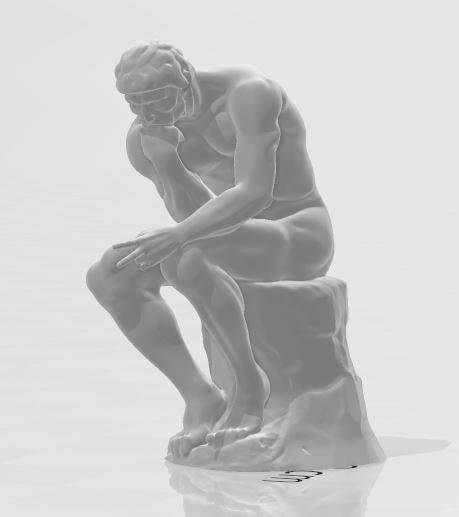
Auguste Rodin created The Thinker as part of The Gates of Hell, a large-scale commission inspired by Dante's Inferno. The figure was originally called The Poet and was meant to represent Dante himself, observing the souls below. Rodin later enlarged it and the image circulated as The Thinker, losing its specific Dante reference and becoming a general symbol of contemplation.
The figure is unmistakable: a man seated on a rock, chin resting on his fist, body bent forward in the posture of intense concentration. He is thinking harder than anyone in the history of sculpture. Every muscle is engaged in the effort of thought. He is not relaxed. He is not comfortable. He is trying to work something out.
This is precisely the wrong state for competitive Rock Paper Scissors.
Overthinking in RPS is a documented performance problem. The game's time pressure — the count, the simultaneous reveal — compresses the decision window to the point where extended deliberation produces worse outcomes than committed instinct. Players who are working too hard to outsmart their opponent generate observable latency: a slight hesitation in the third pump, a tell in the hand that hasn't committed until the last possible moment. Experienced opponents can read late decisions and exploit them.
The ideal competitive state is something closer to the opposite of The Thinker: relaxed attention, a prior read of the opponent's tendencies already processed before the count begins, a committed choice that executes cleanly without second-guessing. The decision should be made before the count. The count is just the execution mechanism.
The Thinker exists in multiple cast versions worldwide. The original, at the Musée Rodin in Paris, is the largest. The figure has been thinking for over a hundred years. He has not thrown a single time.