
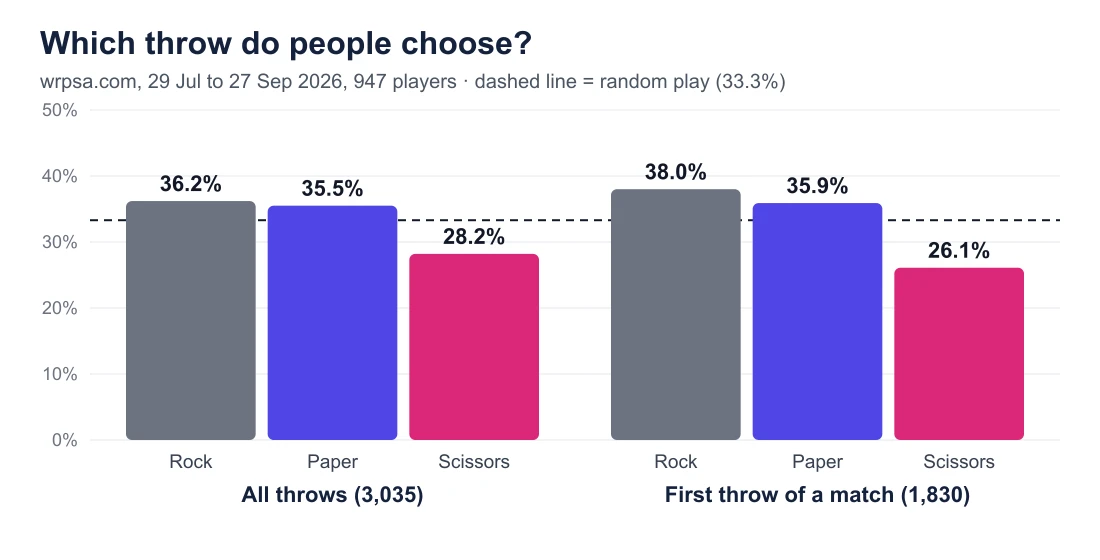
People do not play Rock Paper Scissors at random. In 3,035 throws recorded on wrpsa.com between 29 July and 27 September 2026, rock came up 36.2% of the time and scissors only 28.2%. And after winning a round, players repeated their winning throw just 19.9% of the time, which runs against the best-known study of the game.
This is the first edition of a report I plan to publish every year. The data, the method and the limits are all below, and the aggregate counts are free to download as a CSV file.
The headline numbers
| Measure | Rock | Paper | Scissors | Throws |
|---|---|---|---|---|
| All throws | 36.2% | 35.5% | 28.2% | 3,035 |
| First throw of a match | 38.0% | 35.9% | 26.1% | 1,830 |
If people threw at random, each option would sit near 33.3%. With 3,035 throws, a gap this size is very unlikely to be chance: a chi-square test against an even split gives roughly 36 on two degrees of freedom, far past the usual threshold (p < 0.001). The pattern is sharper on the first throw, when players have no information about their opponent and fall back on habit.
What it means for you: scissors is the throw people avoid, so paper is slightly less likely to be beaten than rock is. Against an unknown opponent's first throw, paper wins against the most common choice and only loses to the least common one.
What players do after winning, losing or tying
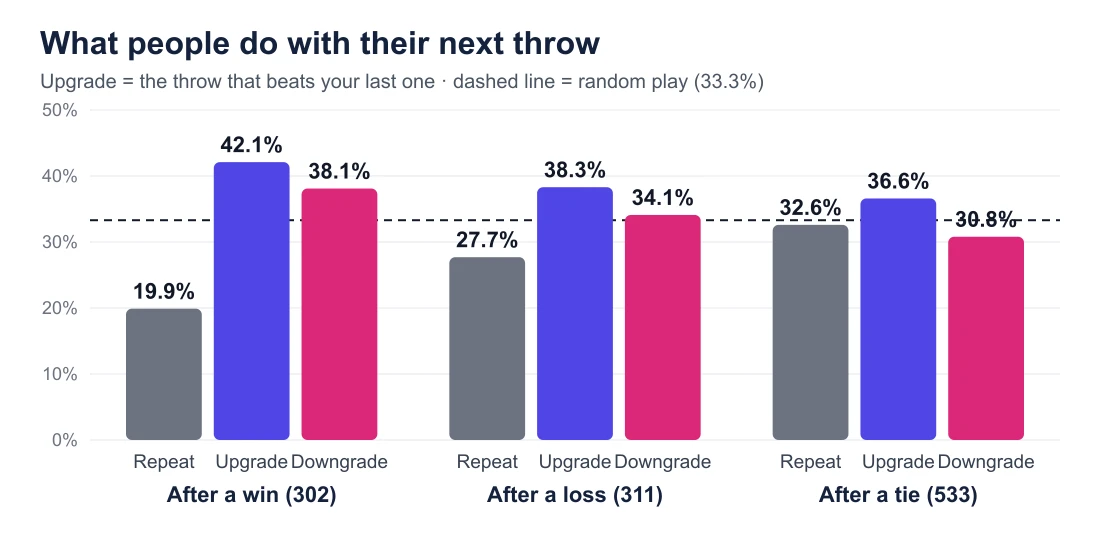
"Upgrade" means moving to the throw that beats the one you just played (rock to paper, paper to scissors, scissors to rock). "Downgrade" means moving the other way.
| After a... | Repeat | Upgrade | Downgrade | Transitions |
|---|---|---|---|---|
| Win | 19.9% | 42.1% | 38.1% | 302 |
| Loss | 27.7% | 38.3% | 34.1% | 311 |
| Tie | 32.6% | 36.6% | 30.8% | 533 |
The result that surprised me is the first row. The most cited study of human Rock Paper Scissors, by Wang, Xu and Zhou at Zhejiang University (2014, 360 students), found that winners tend to stay with the throw that just won. Our players did the opposite: only one in five repeated a winning throw, well below the 33.3% you would expect from random play. A simple test puts that gap at about five standard errors, so it is not noise.
My working explanation is the opponent. Most rounds in this sample were played against the computer, and a player who has just beaten a machine may expect it to adapt and move away from the winning throw on purpose. That is a hypothesis, not a finding, and it is exactly what next year's larger sample of human-versus-human games should test.
After losses and ties, behaviour is much closer to random, with a mild lean toward upgrading.
What it means for you: if your opponent just won with rock, they are least likely to throw rock again. Paper is then a weak choice and scissors a reasonable one, because most of their next throws are paper (upgrade) or scissors (downgrade). There is more on reading patterns in how to predict your opponent's move and the maths in the math of Rock Paper Scissors.
How the data was collected
- Source: every completed round played on wrpsa.com and recorded in the WRPSA match database, 29 July to 27 September 2026.
- Players: 947 distinct accounts, including guest accounts.
- Throws: 3,035. Against the computer only the human's throw is counted. In human-versus-human games both players' throws are counted.
- Transitions: 1,146 pairs of consecutive rounds inside the same match where both throws in each round were recorded.
- Integrity: the computer's throw is sealed with a SHA-256 commitment before the player chooses, so the machine cannot react to the player's throw. The data therefore reflects real choices, not a rigged opponent.
Limits you should know about
- Mostly against the computer. Human-versus-human play is still a small share of these rounds. People may play differently against a person.
- Self-selected players. These are people who came to wrpsa.com to play, not a random sample of the population.
- Short matches. Many matches are only a few rounds long, which is why the transition counts (about 300 per row) are much smaller than the throw count. Treat each transition percentage as accurate to within roughly five points.
- No demographics. wrpsa.com does not record age or gender, so this report says nothing about either.
Use the data
The aggregate counts behind every chart are in state-of-rps-2026.csv. You are welcome to use them with a link to this page. Journalists and researchers who want a different cut can reach us through the contact page.
You can add to next year's sample by playing a few rounds.
FAQ
What is the most common throw in Rock Paper Scissors?
In our data it is rock, at 36.2% of all throws and 38.0% of first throws. Paper is close behind and scissors is clearly the least chosen.
Do winners repeat their throw?
In the best-known lab study, yes. In our data, mostly no: after a win, players repeated the winning throw only 19.9% of the time and switched to the throw that beats it 42.1% of the time.
Is this data reliable?
The throw shares are based on 3,035 throws and are statistically clear. The after-a-result percentages rest on about 300 transitions each, so they are less precise. The biggest caveat is that most rounds were played against the computer.